
Against Those Who Divide Christ
This blog explores **St. Severus of Antioch’s uncompromising defense of the undivided Christ**, warning that to divide Christ in speech is to fracture salvation itself. Through pastoral clarity and scriptural insight, Severus exposes how seemingly reverent language can undermine the mystery of the Incarnation and calls the faithful to hold fast to the Church’s simple, life-giving confession: one Lord, one Son, one incarnate Word.
SAVERIO'S OF ANTIOCH
2/125 Homily of St. Severus of Antioch
1/22/20264 min read
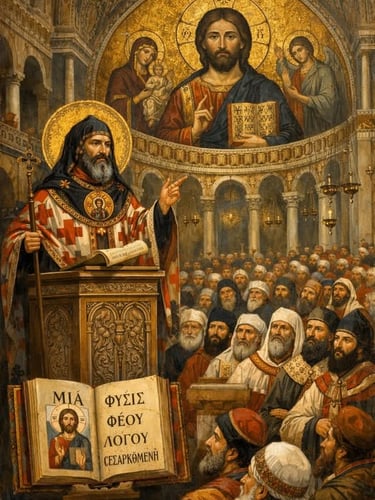
One Christ, Undivided:
St. Severus of Antioch Against the Division of the Savior
In his second cathedral homily, St. Severus of Antioch turns from proclamation to protection. Having already laid the foundation of right faith and the true Incarnation of the Word, he now confronts the most serious danger facing that faith: the division of Christ after the Incarnation. This sermon is not merely polemical in tone; it is deeply pastoral in purpose. Severus understands that divided speech about Christ does not remain a harmless theological exercise—it fractures salvation itself and unsettles the hearts of the faithful.
This homily stands as a warning, a clarification, and a call to vigilance. It exposes how subtle language can undermine the Gospel, and it insists that the Church’s confession must preserve the unity of the One who alone saves.
The Danger of Dividing Christ
Severus begins with a striking assertion: those who divide Christ do not simply make an intellectual mistake—they strike at the root of salvation. Why such severity? Because salvation depends not on a cooperation between two acting subjects, but on one and the same Lord who acts throughout the economy of redemption.
To divide Christ is to undo the Incarnation itself. It introduces confusion where Scripture proclaims unity and replaces the saving mystery with fractured explanations that assign weakness to one subject and glory to another. Severus sees this not as reverence for God, but as a denial of the very means by which God healed humanity.
One Acting Subject in the Economy of Salvation
A central theme of this homily is the unity of the acting subject in Christ. Severus points repeatedly to the Gospel narratives, not to speculate, but to demonstrate a simple and consistent truth: the same One acts in all things.
The One who hungers is the same One who feeds.
The One who sleeps is the same One who commands the winds.
The One who suffers is the same One who raises the dead.
This is not poetic exaggeration—it is the logic of salvation. If the suffering belongs to someone other than God the Word incarnate, then suffering is not healed. If the cross belongs to a lesser subject, then the cross loses its saving power.
For Severus, unity is not an abstract concept; it is the very condition of redemption.
Apostolic Faith Versus Deceptive Speech
Severus contrasts the divided language of his opponents with the clarity of the apostolic proclamation. The apostles, he insists, knew nothing of:
divided subjects,
partitioned actions, or
double modes of speaking about Christ.
They preached one Lord Jesus Christ, the Only-Begotten Son, who became man without ceasing to be God.
The danger Severus identifies is not always blatant heresy, but smooth and pious language that appears reverent while quietly undermining truth. Such speech, he warns, is spiritually deadly—not because it sounds hostile, but because it sounds convincing.
True faith, by contrast, is simple, whole, and life-giving.
The Homily Text
HOMILY 2: Against Those Who Divide Christ
(Cathedral Homily of St. Severus, Patriarch of Antioch)
Those who divide Christ, beloved brethren, do not merely err in words, but strike at the very root of salvation. For they dare to separate what God has inseparably united, and by their reckless speech they wound the faith of the simple.
When the divine Scriptures proclaim that the Word became flesh, they do not announce two realities acting side by side, but one and the same Lord accomplishing our salvation. It is the same One who hungered and who fed the multitudes; the same One who slept in the boat and who rebuked the winds; the same One who suffered on the cross and who raised the dead by His word.
Yet those who delight in division assign the lowly things to a man and the glorious things to God, as though Christ were split into two subjects. In doing so, they do not honor God, but deny the mystery by which God saved the world. For if it is not God the Word who truly suffered in the flesh, then our suffering is not healed; and if it is not the same One who is glorified, then the cross is emptied of its power.
The apostles did not preach such confusion, nor did the fathers hand down such a mutilated Christ. They proclaimed one Lord Jesus Christ, the Only-Begotten Son, who for our sake became man without ceasing to be God. They knew no double speech, no division of persons, no partition of actions.
Let no one therefore be deceived by smooth words that pretend reverence while undermining truth. For heresy often clothes itself in pious language, yet its fruit is death. The faith of the Church is simple, whole, and life-giving: one Christ, one Son, one incarnate Word.
Hold fast, then, to this confession, and do not permit your mind to be torn apart by those who delight in disputation rather than truth. For just as Christ is one, so also is the hope of those who believe in Him.
May He who united humanity to Himself without division preserve us in the unity of the true faith, now and unto the ages of ages. Amen.
A Call to Steadfast Confession
This homily leaves the listener with a clear choice: unity or fragmentation, life or confusion. Severus does not invite endless disputation, but faithful perseverance. Just as Christ Himself is one, so too is the hope of those who believe in Him.
In a Church often tempted to explain the mystery away rather than confess it, St. Severus calls believers back to a simple and saving truth: the One who saves us is not divided. To guard that confession is not merely to defend doctrine—it is to safeguard the Gospel itself.