Participation in the Divine Nature
This article presents a clear and uncompromising contrast between Eastern and Western Christian theology, centering on the meaning of salvation. Drawing from Scripture and the lived liturgical tradition of the Syriac and Orthodox Churches, it argues that true salvation is not a legal acquittal from punishment but ontological participation in divine life—becoming partakers of the divine nature. Through the Incarnation, Christ united humanity to divine life, initiating a process of transformation “from glory to glory” that begins in baptism and unfolds through sacramental life, illumination, and theoria. The article critiques the historical infiltration of Western legalistic theology into Malankara Christianity, exposing the deep contradiction between Eastern worship and Western preaching, and calls believers to recover the authentic Eastern Gospel that alone harmonizes theology, liturgy, and lived faith.
Br Shibu Peediyekkel
1/31/20269 min read
Participation in the Divine Nature
Saint Peter the Apostle, in his second epistle (chapter 1:4), speaks about an exceedingly great matter. God has given us precious promises so that we may become “partakers of the divine nature.” Have you ever reflected on the depth of this promise? The truth is this: in order for us to become equal with God, God Himself became like us!
He descended so deeply into our midst, into the very environment of each one of us. He came and experienced all our anxieties and burdens. Not only disappointment, pain, and sorrow that a human being experiences, but even hatred, vengeance, hostility, and bitterness—He personally encountered and knew them. He assumed every human emotion. This is the heartbeat of Eastern theology.
Here lies the great difference between East and West. Today, most of the sermons we hear in Kerala are influenced by Western thought. Even those who claim to be Eastern churches are only now attempting to return to their roots. For example, the Syro-Malabar Church has recently begun to declare loudly that it is an Eastern Church. We can see changes in their liturgy and their efforts toward Easternization.
In truth, we are the children of the Syriac Church, which has inherited—by tradition—a beautiful liturgy enriched by Eastern theology. Yet, sadly, while holding this great treasure in our hands, many are straying into destructive Western doctrines. How pitiable it is to follow someone’s preaching blindly, without recognizing the deep Eastern vision embedded in our own liturgy!
That is why we strive to proclaim this “Glorious Gospel” in its true meaning. The sacred theology of our Church must not remain mere ornamentation; it must become part of our very life.
So what is this Eastern vision? What is the Eastern Gospel? The Western gospel is a destructive sectarian doctrine, whereas the Eastern Gospel is the life-giving true Gospel. How does Western theology differ from this? What is the core of the Eastern Gospel? We can see it clearly in this verse—that we are able to become partakers of the divine nature.
How do we partake in this divine nature? Western gospel preachers also carry a Bible, and if you show them this verse, they too will nod in agreement. But immediately they begin to interpret it. They cut and trim it to fit their doctrines and perspectives, like cutting a foot to fit a shoe. That is what happens there.
Look at what Saint Paul the Apostle says:
“I have been crucified with Christ; it is no longer I who live, but Christ who lives in me.”
Christ lives in me; Christ works in me—this is participation in the divine life.
In Western gospels, most preaching centers around “salvation.”
“Brother, are you saved?”
“What should I do to be saved?”
These were their common questions. But today, Pentecostals do not even ask such questions anymore.
Why? Because when we look back over the past seven years of the Glorious Gospel, we were able to silence many of them. Our success lies in making them realize that Pentecostal doctrine is something that cannot be openly defended. Even leading Pentecostal pastors are now beginning to reject their old teachings. They have realized that those teachings are irrational and riddled with errors.
In the 2024–25 period, we are witnessing major changes. They are upgrading their doctrines, revising them—they are evolving. The fundamental reason for all this is that we preached these truths. I am not prepared to give the credit to anyone else.
Do you understand? What you are seeing is the success of the Glorious Gospel. We are forcing them to say these things. They may think they can survive by changing costumes, but I predict they will not be able to. Because this is a foundational change. Pentecostal doctrine cannot be fixed or reformed—it is not reformable. Thinking it can be improved is like believing that feeding more oil-cake to a donkey will turn it into a horse. The difference lies in the foundation itself.
These two theological perspectives—Eastern and Western—are as different as East and West, like sunrise and sunset. That is why I remain so “cool.” Many people steal ideas from here, but nothing significant will come of it. Because the platform itself must change. An app developed for the Apple platform (macOS) will not work on an Android phone, will it?
Our theology fits correctly only within an Eastern framework. If you take these ideas and place them within a Western framework, they will not work. It is like plucking a jackfruit from a breadfruit tree and hanging it on a different tree in your own yard. It may look delicious and seem like a honey-jackfruit, but it has no connection to that tree—it has no roots. Its platform is different.
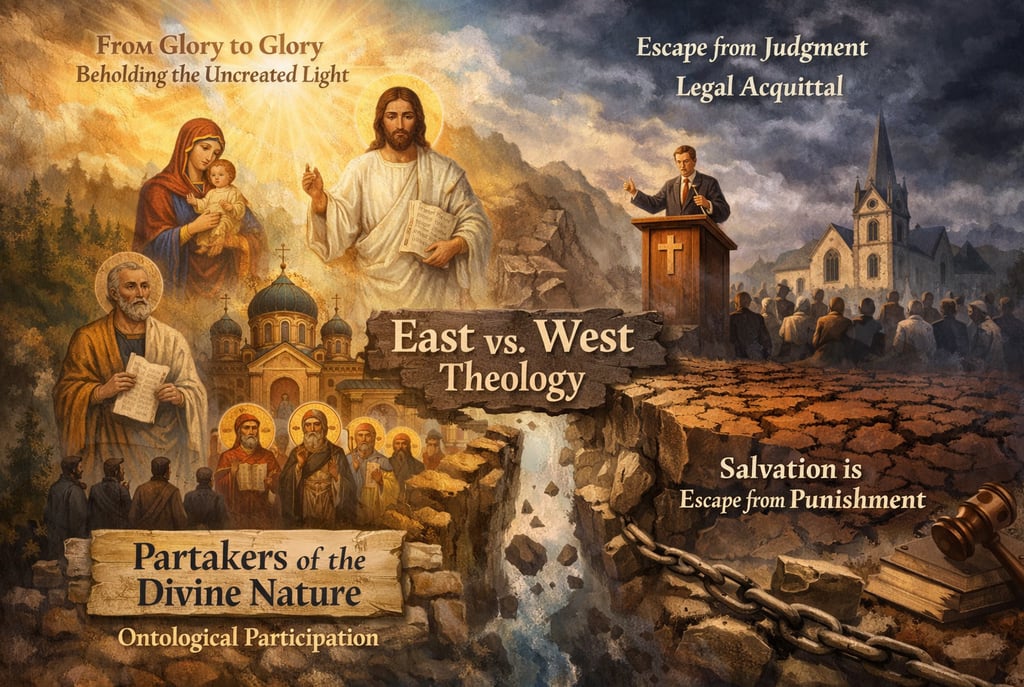
I mentioned two basic changes earlier. The most important among them is the perspective on salvation. What is salvation? In the Eastern understanding, salvation is ontological participation. It is not merely a legal acquittal. But in the Western gospel, salvation is viewed within a legal framework—as if a guilty person is legally acquitted or released. All their sermons and illustrations remain confined to this level.
You must be very attentive here—this is a hairpin turn. Once you cross this turn, things become clear. In Eastern theology, salvation means ontological participation, participation in divine life. But in the Western gospel, salvation means deliverance from punishment—they teach that we deserve punishment and that salvation is being spared from it.
Observe the sermons of priests today in the Malankara Orthodox Church, the Jacobite Church, or the Mar Thoma Church—they too proclaim this same Western vision. The Glorious Gospel is not the doctrine of any one denomination; rather, it proclaims true Orthodoxy (Pure Orthodoxy). The reality is that preachers in these churches today are proclaiming Pentecostal-style Protestant absurdities. Ordinary people must understand this—you are being deceived. Even while claiming to be Eastern, what you are being taught is Western ideology.
There is a history behind this. In the past, Anglican missionaries were hostile toward the Jacobite Church. The method they discovered to undermine the Church’s foundation was a capable man educated at Madras Christian College—P. T. Geevarghese. He was a “Trojan horse” sponsored and sent into the Malankara Church by the English. This M.A. priest, together with Vattasseril Geevarghese Ramban, planted a tunnel within the Church.
They accepted the Englishman’s invitation and visited Serampore in Calcutta, receiving large sums of money. They agreed to a condition that the English would conduct examinations for Malankara theological students. This was a highly strategic move—an opportunity to rub our clergy’s theology against Western gospel ideas and brainwash them. Whatever money the English spent was profit for them. It was a move that pawned a people’s thought, self-respect, and mind at the feet of the Englishman.
Although the Malankara Church later split into two factions, even today Jacobite and Orthodox clergy continue with the same agreement imposed by the English. Their affiliation is still with Serampore. What they study even now is Western theology. With the money given centuries ago, the English purchased an entire people’s worldview.
Think about it: our prayers are perfectly aligned with Eastern vision. Look at the beautiful liturgy of Mor Geevarghese Sahdo, beginning with “This is the time of prayer…” The entire Jacobite liturgy is Eastern. It will never align with Western theology—they are like oil and water. What happens if you pour petrol into a diesel engine? The vehicle will not move; it will not start. Pour diesel into a petrol engine, and it will explode.
For the past hundred years, this has been the condition of the Jacobite Church. Like pouring petrol into a diesel engine, the Church has been unable to advance theologically. Had the Eastern Gospel been preached in Malankara in harmony with Eastern liturgy, the Church’s present position would be beyond imagination. Eastern theology is that radiant and eternal. What is happening here is this: on one side, Western theology is preached; on the other side, Eastern liturgy is recited. This creates a profound conflict.
Because of this contradiction, questions arise among believers:
“Why pray for the dead?”
“Why the Qurbana?”
“Why the sacraments?”
When clear answers are not received, many leave the Church. Those who remain stay physically inside but are mentally divorced from the Church. Even organizations like St. Paul’s Mission within the Jacobite Church follow Pentecostal doctrines. I possess evidence of the Western theology preached by your fathers and grandfathers.
Pentecostal families who returned to the Jacobite Church after hearing the Glorious Gospel are told by women’s association members in that parish: “Do not recite the Metta, okay?” Such hostility toward the Mother exists even among those who remain in the Church. They have abandoned the Church in their hearts. They are the kind of people described as: “You have a name that you live, but you are dead.”
All this is the result of the Western gospel preached for the past hundred years. It cannot merge with Eastern worship. But preach Eastern theology, and it will match your liturgy and release immense power into the Church. With that Calcutta journey undertaken by P. T. Geevarghese and Vattasseril Ramban, the fate of the Malankara Church was sealed. On that dark day, they sold the Church. This is the damage Western gospel inflicted on Malankara. It is a cruel reality, and every believer must recognize it.
Have you ever wondered why these inconsistencies exist among us? Many feel that the doctrines, liturgy, and sacraments of the Jacobite Church are unbiblical. In 2024, I even heard a priest say that people go and smash an envelope for ten rupees. Why such lack of confidence? Because what they learned and what they teach exists within a Western framework. This contradiction arises from maintaining Eastern worship while dispensing Western doctrine.
We must first recognize this change in the understanding of salvation. For the West, salvation means deliverance from punishment. But in the Eastern vision, salvation is ontological participation—we partake in God’s being and His life. That is why we become partakers of the divine nature. When did this happen? The process of salvation began the moment our Lord Jesus was born in Bethlehem.
This is a Gospel that has never been preached in Malankara before. Through the very birth of Jesus, we received deliverance. The angels sang and rejoiced about this great salvation. From the moment the Son of God was born as man, we became members of the household of God. This is not merely a legal declaration (external imputation), but a transformation that occurs within our very being.
As Athanasius the Great said:
“He became like us so that we might become like Him.”
With this understanding, no one will frown at the Church’s praise of the Holy Virgin Mary. Not only Mary, but all of us must be transformed into that image, receiving glory upon glory from His fullness. Saint Paul, in 2 Corinthians chapter 3, speaks about growing “from glory to glory.” We are not growing from ashes to glory, but from the glory given to us through the Incarnation to ever-greater glory.
This growth begins at baptism. While Westerners think in terms of studying, passing exams, and finally graduating, Easterners grant that graduation at baptism itself. That is why children are crowned at baptism. A crown is given to the victor—and that victory has already been given to us in Christ through baptism. After that, we grow and shine by cooperating with divine grace (synergy).
Saint Paul speaks of real union. With unveiled faces, we behold the glory of the Lord. In Eastern understanding, this “veil” is not legal guilt but spiritual blindness. In Christ, that blindness is removed. There, theoria—divine vision—takes place. We see the Lord face to face and are transformed into that glory.
The Malayalam Bible’s word “kaanmin” does not fully capture the meaning of “beholding”; it is a poor translation. Beholding does not mean merely seeing with the eyes, but experiencing that glory with every cell of our body. To be fully immersed in that glory—this is what “from glory to glory” means. There we behold the Uncreated Light.
I recall an experience from years ago at a Pentecostal prayer meeting. Foreign guests had come, and pastors were making people give testimonies to pass time. A woman stood up and said, “I saw a great light during worship.” In reality, someone there had taken a photo using a flash. What she saw was created light. But the ultimate goal of an Orthodox believer is not sunlight or electric light, but to behold the Uncreated Light itself.
In Orthodox tradition, we pray not with eyes closed but with eyes open. This spiritual vision is not attained through arguments or debates, but through illumination. As Saint Gregory of Nyssa said, when a soul turns toward God, the veils are removed and it begins to see Him in His true nature.
Salvation is not merely declaring forgiveness by checking a list of sins. It is spiritual healing and illumination. We become partakers of the divine nature. This is what is called theoria. We are members of the body of Christ. United to that body, we share His divine life. This is the greatest mystery of Eastern theology.
May the prayers of the Holy Virgin Mary, the Mother of God, and of all the saints, be our fortress.