
Jonah, the Fast of Nineveh, and the Mystery of Death and Resurrection
Jonah, Sheol, and the Three Days How the Fast of Nineveh proclaims Christ’s death, descent into Hades, resurrection, and the Church’s call to repentance.
1/29/20265 min read
Jonah, the Fast of Nineveh, and the Mystery of Death and Resurrection
A Syriac Orthodox Patristic Theology of the Three Days
Abstract
The Fast of Nineveh occupies a unique position in the liturgical and theological life of the Syriac Orthodox Church. Unlike other Old Testament commemorations, it has been preserved, formalized, and venerated as a living ecclesial mystery. This article argues that the reason lies in the Syriac patristic understanding of Jonah not merely as a moral prophet but as a type of Christ’s death, descent into Sheol, and resurrection. Drawing upon direct citations from St. Ephrem the Syrian, St. Jacob of Serugh, and St. Severus of Antioch, and examining the historical contribution of Mor Morutho in institutionalizing the fast, this study demonstrates that Jonah’s experience was understood as a real participation in the realm of death. The article further critiques modern Western theological reductions of Jonah typology and shows how the Syriac Orthodox tradition preserves the full paschal mystery—death, descent, resurrection, repentance, and ecclesial life—fulfilled today through confession and the Holy Eucharist.
1. Introduction: The Singular Place of the Fast of Nineveh
Within the Syriac Orthodox liturgical calendar, the Fast of Nineveh stands apart. It is the only fast derived from the Old Testament that is solemnly observed as a universal ecclesial fast, while all other major feasts commemorate the life of Christ, His Mother, and the Apostles.
This fact itself demands theological explanation. The Syriac Orthodox Church does not preserve feasts merely for historical memory, ethical instruction, or narrative symbolism. What it preserves is mystery—events that reveal Christ and continue to act sacramentally within the Church.
The Fast of Nineveh survives because Jonah is not merely a prophet of repentance; he is a figure of the Crucified and Risen Lord. The fast is not about fasting as moral reform, but about death interrupted by divine mercy, repentance after judgment, and resurrection offered to the nations.
2. The Scriptural Foundation: The Sign of Jonah
The interpretive key is given by Christ Himself:
“For just as Jonah was in the belly of the fish three days and three nights, so will the Son of Man be in the heart of the earth three days and three nights.”
(Matthew 12:40)
Christ does not compare Jonah to preaching, obedience, or endurance. He explicitly aligns Jonah’s experience with His burial and descent into the earth. The Syriac Fathers insist that this parallel is theologically coherent only if Jonah truly entered a state belonging to death.
This is confirmed by Jonah’s own testimony:
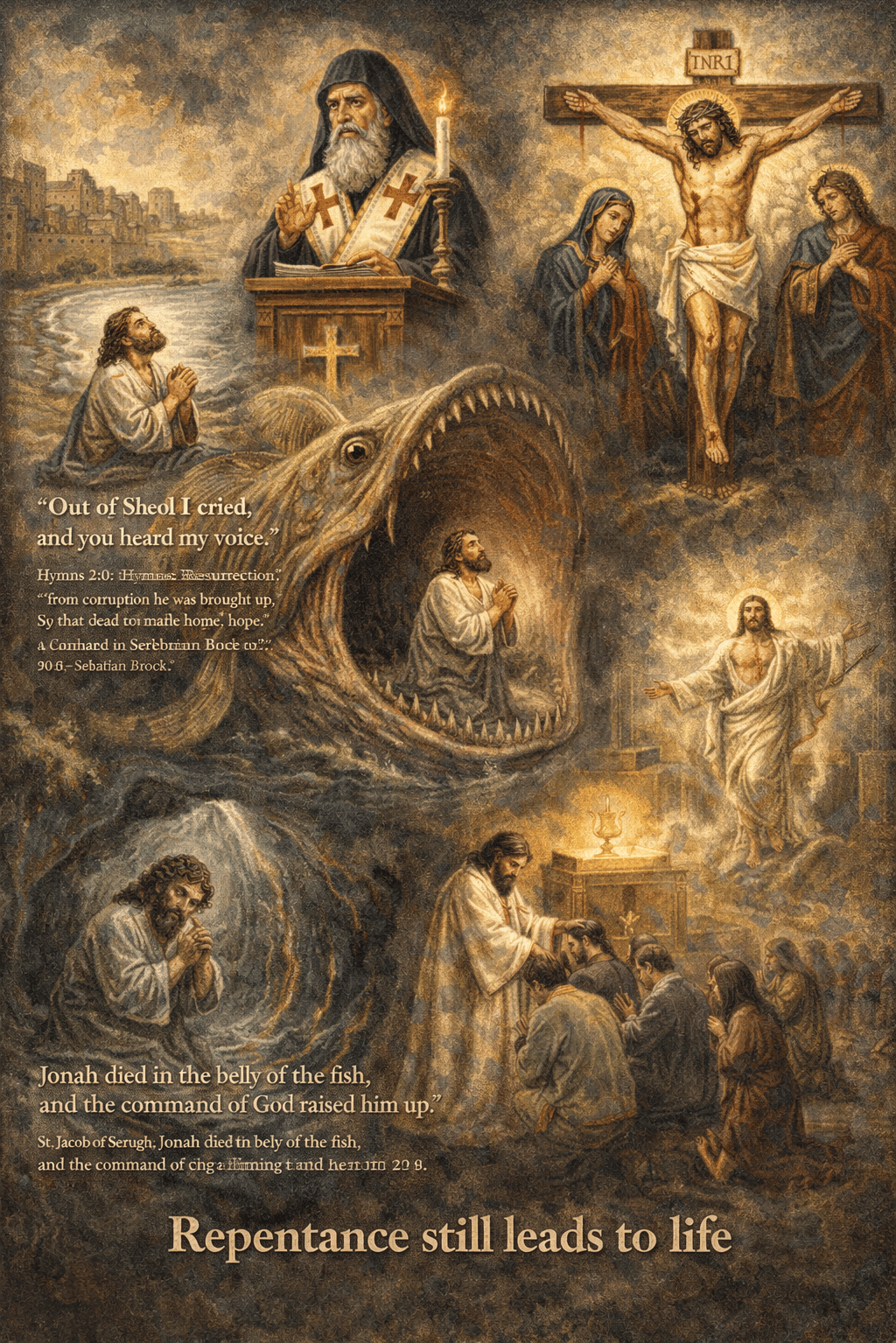
“Out of Sheol I cried, and You heard my voice.”
(Jonah 2:2)
In Syriac theology, Sheol is not poetic exaggeration. It is the realm of death, silence, and separation from human activity. Jonah does not cry from danger; he cries from the place of the dead.
3. St. Ephrem the Syrian: Jonah as Descent and Resurrection
3.1 Jonah’s Cry from Sheol
St. Ephrem the Syrian (†373), the foundational theologian of Syriac Christianity, treats Jonah with remarkable theological precision. In his resurrection hymns, Ephrem writes:
“Jonah descended into the depths,
and from the belly of Sheol he cried out.
From corruption he was brought up,
so that the dead might have hope.”
(Hymns on the Resurrection, Hymn 2; trans. Sebastian Brock)
Here, Jonah’s experience is not danger but descent, not survival but restoration from corruption. Ephrem explicitly connects Jonah’s return with hope for the dead, making him a witness to resurrection.
3.2 The Fish as a Tomb
Ephrem further clarifies the nature of Jonah’s confinement:
“The fish became for him a grave,
and from it he arose alive.”
(Hymns on the Unleavened Bread, Hymn 9)
The imagery is unmistakable. The fish is not a vessel of preservation but a grave, and Jonah’s emergence is described as a rising, not an escape.
3.3 Safeguarding Christology
Ephrem is aware of the Christological implications:
“If Jonah had not truly descended,
the sign of the Son of Man would be emptied of its power.”
(Commentary on the Diatessaron, on Matthew 12)
Thus, Jonah’s descent safeguards the reality of Christ’s death and descent into Hades. Any weakening of Jonah weakens Christ.
4. St. Jacob of Serugh: Jonah Who Died and Was Raised
St. Jacob of Serugh (†521), the great homilist of the Syriac Church, is even more explicit.
4.1 Explicit Language of Death
In his homily on Jonah, Jacob states plainly:
“Jonah died in the belly of the fish,
and the command of God raised him up.”
(Homily on Jonah and the Repentance of Nineveh)
This is not metaphorical language. Jacob deliberately uses death and resurrection terminology, leaving no room for survivalist interpretations.
4.2 The Fish as a Tomb Approaching Corruption
Jacob continues:
“The fish enclosed him as a tomb;
corruption approached him,
but the Living One guarded His sign.”
Jonah approaches corruption but is preserved—precisely as Christ’s body in the tomb “did not see corruption” (Psalm 16:10).
4.3 Why Nineveh Believed
Jacob offers a striking theological insight:
“Nineveh believed because a dead man preached to her.”
Jonah’s authority arises not from eloquence but from having passed through death. This mirrors Christ’s post-resurrection preaching through the Apostles.
5. St. Severus of Antioch: Christological Precision
St. Severus of Antioch (†538), the great defender of Miaphysite Christology, approaches Jonah with doctrinal restraint but theological clarity.
5.1 Held in the Realm of Death
Severus writes:
“He was held in the place belonging to death,
until the command restored him.”
(Homily 67, Patrologia Orientalis XXIX)
Severus avoids biological speculation, but affirms a real death-state followed by divine restoration.
5.2 Protecting the Descent into Hades
Severus warns:
“If Jonah did not truly descend into the realm of the dead,
then Christ’s descent is reduced to speech alone.”
For Severus, Jonah’s reality protects the Church from docetism, Nestorian separation, and symbolic reductions of salvation.
6. Mor Morutho and the Institutionalization of the Fast
6.1 Historical Role of Mor Morutho
Mor Morutho (7th century) did not invent the theology of Jonah but recognized its ecclesial necessity. He formalized the Fast of Nineveh as a universal observance, placing it before Great Lent.
6.2 Why This Fast Was Preserved
Mor Morutho understood that:
Jonah is a resurrection preacher
Nineveh is a prototype of the Church
repentance after judgment leads to life
Thus, the fast was preserved not as history but as living proclamation.
7. Nineveh as the Image of the Church
In Syriac theology, Nineveh represents:
the nations
the Church gathered from death
repentance leading to life
Jonah, who descends and rises, preaches repentance; Nineveh responds and lives. This pattern is fulfilled today in the Church through:
confession
absolution
the Holy Eucharist
Christ now preaches repentance through His Church, just as Jonah preached after his return from death.
8. Critique of Modern Western Approaches
Modern Western theology often:
reduces Jonah to moral obedience
denies or ignores Jonah’s descent into death
treats Christ’s descent into Hades as symbolic
As a result, the Gospel is fragmented:
suffering without descent
death without victory
resurrection without transformation
The Syriac Orthodox Church preserves the entire paschal sequence:
suffering → death → descent → resurrection → preaching → ecclesial life
9. Conclusion: Why the Fast of Nineveh Endures
The Fast of Nineveh endures because it proclaims the whole Christ.
Jonah truly descended.
Christ truly died.
Christ truly entered Hades.
Christ truly rose.
And repentance still leads to life.
Nineveh still stands—now as the Church—where all who repent receive eternal life through confession and the Holy Eucharist.
Bibliography (Selected)
Ephrem the Syrian, Hymns on the Resurrection, trans. Sebastian Brock
Ephrem the Syrian, Commentary on the Diatessaron
Jacob of Serugh, Homilies, trans. Sebastian Brock
Severus of Antioch, Homilies, Patrologia Orientalis XXIX
Brock, Sebastian. The Luminous Eye
Patrologia Orientalis, vols. XX–XXIX